DigSilent PowerFactory Co-simulation
Co-simulation Environment
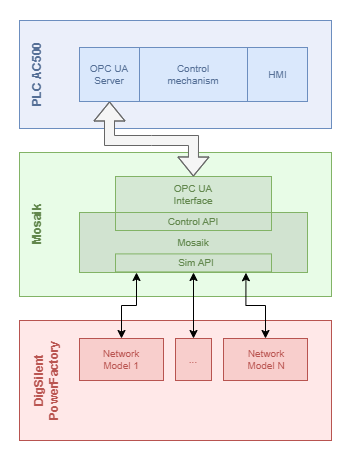
Co-simulation is a methodology for simulating complex systems by coupling multiple specialized simulation tools into a single, coherent model. This project implements a co-simulation environment using the Mosaik framework to bridge the professional power system simulator DIgSILENT PowerFactory with an ABB AC500 V3 PLC controller over the OPC UA protocol.
System Architecture
The system is composed of three core components:
- DIgSILENT PowerFactory — models the electrical behaviour of the power grid and acts as the controlled plant
- ABB AC500 PLC controller — executes control algorithms and protection logic in real time
- Mosaik framework — orchestrates time synchronization and data exchange between all components
Inter-component communication relies on the OPC UA protocol, providing reliable, standards-based data transfer at each simulation step.
Mosaik Framework
Mosaik is an open-source, Python-based co-simulation framework that provides the infrastructure for coupling heterogeneous simulators. Key capabilities include:
- Flexible adapter-based integration of arbitrary simulation tools
- Deterministic time-step synchronization across components
- Declarative scenario configuration
- Modular, extensible architecture
DIgSILENT PowerFactory Integration
PowerFactory is connected to the co-simulation through a dedicated adapter responsible for:
- Interfacing with the PowerFactory Python API
- Managing simulation time alignment with the global schedule
- Handling cyclic read/write data exchange between the grid model and the rest of the environment
PLC Controller Integration
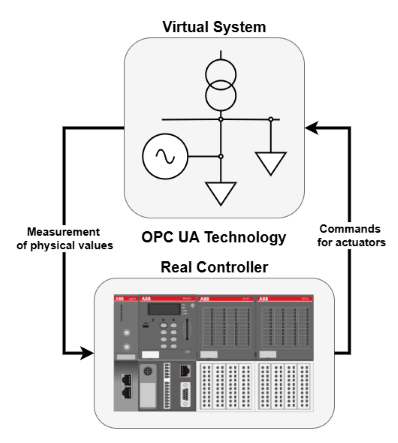
The control software runs on the ABB AC500 platform and is linked to the simulation via a custom OPC UA adapter. At each time step, the controller receives measurement values from the simulated grid, executes its control and protection algorithms, and returns setpoints to PowerFactory. The OPC UA protocol ensures standardized, secure, and scalable data transfer between the physical controller and the virtual plant.
Results & Benefits
- Safe validation — real control algorithms can be tested against a detailed grid model before on-site deployment
- High-fidelity simulation — coupling professional-grade tools produces accurate dynamic system behaviour
- Configurability — network topologies, controller parameters, and fault scenarios can be changed without hardware modifications
- Extensibility — additional simulators or devices can be added to the environment through new Mosaik adapters
- Detailed study of the behaviour of complex systems in a safe simulated environment